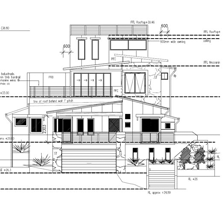

A typical vector file would contain:
- Associative hatch patterns
- Accurate text
- Accurate layer information
- Associative dimensions
- Accurate line types
- Symbols & blocks of standard components
- Title blocks (according to scale)
At Format Conversion our 2D to 3D CAD conversion services help you to convert your 2D images or drawings to 3D models. This helps you increase the usability of your documents.
3D Modeling and Programming:
At Format Conversion, we create the electronic files for making moulds required for production and manufacturing. We create a 3D visualization so that you get a fair idea of how the moulds would look at the time of delivery, as this saves you time as well as money. Mould making requires huge investments. Many a time 2D drawings do not give you a clear image, leading to waste in time and money. Our 3D modeling gives you a computer image of your moulds and reduces the risk of errors.
CNC machines:
- We also do the programming required by the CNC machines which create these moulds.
- The abbreviation CNC stands for Computer Numerical Control, and refers specifically to a computer "controller”.
- It reads G-code instructions and drives the machine tool.
- It’s a powered mechanical device typically used to fabricate metal components by the selective removal of metal.
- Our programmer can make if/then/else statements, loops, subprogram calls, and manipulate variables to create a large degree of freedom within one program. An entire product line of different sizes can be programmed, according to the consumer needs.
Our 2D to 3D CAD conversion service also provides you with rendering and patent drawing services. We render your 2D images to 3D models, which gives you an insight on how your future product would look. It also helps in advertising, designing and modifying the prologue of your product.
Patent drawing requires a specific format to be followed, keeping in mind the layout we create the patents for you, saving your time and labor. The United States Patent and Trademark Office (PTO or USPTO) is an agency in the United States Department of Commerce that provides patent and trademark protection to inventors and businesses for their inventions and corporate and product identification.
We can convert your hand sketches, drawings or images by the standards of the USPTO.
Rendering is the process of generating a model from an image, by means of computer programs. The model is a description of three dimensional objects in a strictly defined language or data structure.
It would contain geometry, viewpoint, texture and lighting information. Our rendering service is of great use for architects and constructors. We can create walkthroughs, based on your 2D images, which are a visualization of your end product. Rendering also has uses in computer and video games, simulators, movie or TV special effects, and design visualization –each employing a different balance of features and techniques.
3D computer graphics are different from 2D computer graphics, in that a three-dimensional representation of geometric data is stored in the computer for the purposes of performing calculations and rendering 2D images. Such images may be for later display or for real-time viewing. In computer graphics software, the distinction between 2D and 3D is occasionally blurred; 2D applications may use 3D techniques to achieve effects such as lighting, and primarily 3D may use 2D rendering techniques. |